Voice Leadings on Abstract Musical Pitches
In the last post, we discussed the notion of abstract musical pitches. I was writing that under a haze of covid-inspired single-parenting, so we’re going to take a few more minutes to try to clarify some of the claims made in that one, before moving on to doing more interesting things with the concept.
In Haskell we have this function quotRem :: Integral a => a -> a -> (a, a), which computes the quotient and remainder of one number divided by another. For example, quotRem 25 5 == (5, 0), quotRem 25 6 == (4, 1), quotRem 25 7 == (3, 4). You get the picture.
Our Deg n type from yesterday operates over quotRem _ n. That is, any degree we might have, say k :: Deg n, we compute its quotRem k n to get (octave, pitchClass). This motivates why we were using functions Fin n -> Fin m to model “scales” mapping from Deg n into Deg m — we want to map only the pitchClass part of the quotRem.
To be more precise, if we want to map a Deg n into Deg m, we run this function:
scale :: (Fin n -> Fin m) -> Deg n -> Deg m
scale f (Deg dn) =
  let (oct, pc) = quotRem dn n
   in Deg $ fromEnum (f (toEnum pc)) + oct * m
This mapping only of pitch classes ensures we maintain the quotienting structure of Deg n that requires k + n to be the same pitch class as k.
Musically, none of this should be unfamiliar. In a diatonic scale, you have 7 distinct notes — let’s label them “do, re, mi, fa, sol, la, ti.” These correspond to 0, 1, 2, 3, 4, 5, 6 :: Deg 7. If you start at any of these notes and go up (or down) 7 times, you will get back to the same pitch class an octave higher (or lower.)
The same argument works for the chromatic scale, where we have 12 notes, labeled “A, A#, B, C, C#, D, D#, E, F, F#, G, G#”. Express these as 0, 1, ..., 11 :: Deg 12, and then go up or down 12 spots and you end up back where you were, modulo an octave.
Similarly, if we want to map from the diatonic scale (Deg 7) to the chromatic scale (Deg 12), we choose 7 pitch classes from the 12 available, and respect the octave equivalence (this mapping is given implicitly by a key signature and, in notated music, a clef.)
If none of these music words make any sense to you, don’t worry. It doesn’t matter.
Intrinsic Scales
Check this out: nothing says we need to have a statically-known-at-compile-time n for our Deg n. As an illustration, here’s the beginning of the Star Wars theme:
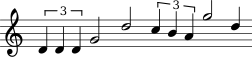
Out of the 7 diatonic pitch classes, this segment of the theme uses only five: do, re, mi, fa, sol, la, ti. So we can project the Star Wars theme down to a 5-note clef:
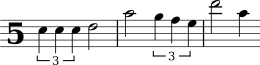
and give a mapping:
starWarsScale :: Deg 5 -> Deg 7
starWarsScale 0 = 0
starWarsScale 1 = 1
starWarsScale 2 = 4
starWarsScale 3 = 5
starWarsScale 4 = 6
which, of course, when we apply that mapping back to the 5-note version, gives us back the song we started with. But before transforming it back, we can do funny things, like fmap (+ 1) in the 5-note scale:
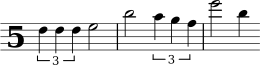
Mapping this back to Deg 7 (and then all the way to concrete pitches) gives us this neat little take on Star Wars:
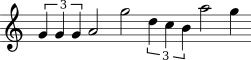
Not as good as John Williams’ to be sure, but it’s interesting that we can do this transformation!
All of this is to say that for any Foldable and Functor collection of notes, we can get its intrinsic scale via intrinsic:
intrinsic
  :: (Foldable f, Functor f)
  => f (Deg n)
  -> (forall i. (Fin i -> Fin n) -> f (Deg i) -> r)
  -> r
which is “you give me some collection of Deg ns, and I’ll give you back a collection of Deg is, as well as a scale from Fin i -> Fin n”. Where i is some unknown-at-compile-time number corresponding to however many unique pitch-classes were in your collection.
As we have seen with the Star Wars example, we can find the intrinsic scale for horizontal structures.1 But of course, this is parameterized over any Functor/Foldable type constructor f. So we can find lots of intrinsic scales — think chords and vertical structures. But probably also more things if I were more imaginative!
Efficient Voice Leadings
We are going to need a few “scales” to work with in this section. We’ll take two common mappings from Western tonal music, namely the 3-in-7 mapping (“triads”), and the 7-in-12 mapping (“the diatonic scale”.)
triad :: Fin 3 -> Fin 7
triad 0 = 0
triad 1 = 2
triad 2 = 4

diatonic :: Fin 7 -> Fin 12
diatonic 0 = 0
diatonic 1 = 2
diatonic 2 = 4
diatonic 3 = 5
diatonic 4 = 7
diatonic 5 = 9
diatonic 6 = 11
If you are not classically-trained in music, don’t worry very much about this. You’d recognize these sounds if you heard them. For example, the triad mapping sounds like any of the examples from the Wikipedia page on arpeggios. The diatonic mapping sounds like this. We’re just arbitrarily choosing some ways of mapping between our abstract degrees (in a way that happens to line up with the arbitrariness of Western musical tradition.)
In Tonality Tymoczko points out that these mappings happen to pretty evenly divide the octave. To illustrate what this means, look at triad: it maps 0..6 :: Deg 3 to 0, 2, 4, 7, 9, 11 :: Deg 7, which if you take the difference between any two subsequent degrees in the image is 2, 2, 3, 2, 2. That’s about as evenly as you could map these things! There’s a tiny little bump in the pattern going from 4 to 7.
The same thing happens in diatonic. We map 0..8 :: Deg 7 to 0, 2, 4, 5, 7, 9, 11, 12, 14 :: Deg 12, which again, taking the difference between subsequent numbers is 2, 2, 1, 2, 2, 2, 1, 2. Very evenly spaced!
Note that this doesn’t actually need to have been the case! This is a property of triad and diatonic, not of Deg {3,7,12}. And Tymoczko makes a pretty compelling argument that this property is why Western music has historically been organized around triad and diatonic.
So why is this important? It’s to do with the slight non-regularity in scale degrees. A big theme of Tonality is that we can very-nearly offset movement in Deg m with an opposite movement in Deg n, and that this is musically interesting (and ubiquitous!)
For example, when working with triad, it happens that moving up by two steps in the intrinsic scale (Deg 3) is almost exactly cancelled out by moving down five steps in the containing scale (Deg 7):
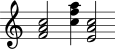
The second chord (black note-heads) here is the first one moved up by 2 :: Deg 3, while the third chord is the second one moved down by 5 :: Deg 7. As you can see, we end up almost exactly where we started, except that the bottom pitch has moved one step down.
In fact, this phenomenon happens again and again if we continue performing these moves. As before, the movement in the intrinsic scale is shown with black note-heads, while the movement in the containing scale is shown with white ones.

Sure enough, this makes pretty pictures. And if you can read the musical notation, you’ll know that what we happen to be computing here are efficient voice leadings from a root note to the diatonic third above it.
In fact, if we remove the in-between black notes, we end up with this:

which sounds like this:
This is likely the sort of thing which is pretty exciting if you’re a musician, and “who cares” if you’re not. It doesn’t really sound like music, but this is in a very real sense a fundamental building block of (Western) music. It’s a way of smoothly getting from one place to another in a musical space. Any time you don’t notice a jarring chord change, this is likely the mechanism by which the music is moving.
Modal Modulations
We can do the same move with 7-in-12 modulations. If we look at the notes of the diatonic (C major) scale as a vertical chord:

Now if we map it up by 4 scale degrees, and down by 7 chromatic degrees we end up here:
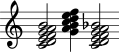
which is either C mixolydian, or a smooth voice-leading into F major, depending on how you look at it.
Making the same up 4 down 7 move again now moves us into C dorian, or Bb major, again, depending on your perspective.
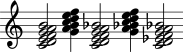
Of course, I didn’t just pick the +4-7 thing out of my brain. Tymoczko has a great tool for computing the moves involved here, and it works for any sized chord inside of any sized scale.
Wrapping Up
A weird one today. Not much in the way of Haskell, and either fascinating or dead boring (depending on how much imagination you have) if you’re into the music theory. In the next post we’ll see about how to formalize all of this into first-class objects. And then we might be getting somewhat close to actually making some music. Maybe?
With some finagling, granted. Those
Events end up being pretty annoying to have to work around! This is a pretty good indication that everyone emailing me saying “you don’t need to model discreteness” are probably right, but I don’t actually know how to make that happen.↩︎