Musical Signal Functions
We’ve been chatting for a few days about my vision for a constructive model of music. So far it’s been rather loosey-goosey; lots of vibes, some semantics, but nothing in the way of implementation. Today let’s get our boots muddy and do enough implementation that we have something concrete to talk about.
Events and Signals
In particular, in Musical Signals we discussed a Signal type that is a continuous function of time, equipped with a set of interesting times that we actually care about. In addition, we proposed an Event type that we will use in conjunction with Signals to signify sparse, discrete functions over time.
Let’s begin with Event. It’s just a little newtype wrapper around Maybe:
newtype Event a = MkEvent
  { eventToMaybe :: Maybe a
  }
  deriving stock (Foldable, Traversable, Generic)
  deriving newtype
    (Functor, Applicative, Monad, Eq, Ord, Show, Alternative, Semigroup, Monoid)

{-# COMPLETE Event, NoEvent #-}
pattern Event :: a -> Event a
pattern Event a = MkEvent (Just a)

pattern NoEvent :: Event a
pattern NoEvent = MkEvent Nothing

event :: b -> (a -> b) -> Event a -> b
event b f = maybe b f . eventToMaybe
As discussed in the footnote on that page, perhaps we want to not export the Event pattern, the MkEvent constructor, or the Applicative/Monad instances. That seems likely like the way to go, but I haven’t yet put much thought into whether it solves all the problems. So let’s export them for now (because they are genuinely useful!) and circle back at some point in the future.
My idea for implementing Signal is to keep around a bunch of continuous segments of function, each of which might have a time-of-interest at the exact instant that the segment starts. A Segment is defined thusly:
data Segment a = Segment
  { segVal :: Maybe a
  , segment :: Time -> a
    -- ^ Must be meaningfully defined for the *entirety* of time!
  }
  deriving stock Functor
The obvious Applicative Segment instance has the wrong semantics here, so we don’t provide it. The problem being that segVal corresponds to a value of the function at a time of interest. Which is to say, that if segVal is ever Just, it must remain Just as we ap our way through it! But Applicative isn’t powerful enough to do that, because filling in the missing data would require us to know what Time we should be sampling the function at.
We address the problem with a new combine function:
-- | Like 'liftA2' for 'Segment', when we have a concrete time to sample at.
combine :: Time -> (a -> b -> c) -> Segment a -> Segment b -> Segment c
combine t f (Segment a fa) (Segment b fb) =
  Segment
    ( asum
       [ liftA2 f a b
       , fmap (f (fa t)) b
       , fmap (flip f (fb t)) a
       ])
    (liftA2 f fa fb)
The asum here attempts to fill in the interesting value by combining the Maybes. If that fails, it then tries to fill it in by fmapping over either individual interesting value.
Collecting our Segments into a Signal requires a few helper functions: merge takes two sorted lists of pairs, and computes a sorted list of These. The idea being that if both lists have a key at the same index, we keep both of them around. If only one has a value, we tag it with which list it came from:
-- | Specialized 'Data.Align.align' for sorted pairs.
merge :: Ord a => [(a, b)] -> [(a, c)] -> [(a, These b c)]
merge [] ys       = fmap (fmap That) ys
merge (x : xs) [] = fmap (fmap This) (x : xs)
merge xx@((tx, x) : xs) yy@((ty, y) : ys) =
  case compare tx ty of
    LT -> (tx, This x) : merge xs yy
    GT -> (ty, That y) : merge xx ys
    EQ -> (tx, These x y) : merge xs ys
We use merge to define joining, which does a scanl of two sorted lists of Segments. The idea here is that the two lists are effectively interval trees, and the intervals are not guaranteed to line up. So we use a scanl hold onto the old value of each until it gets replaced with a new value.
joining
    :: Ord a
    => Segment b
    -> Segment c
    -> [(a, Segment b)]
    -> [(a, Segment c)]
    -> [(a, (Segment b, Segment c))]
joining a0 b0 as bs
  = drop 1
  $ scanl
    (\(_, (a, b)) (t, th) ->
      case th of
        This a'     -> (t, (a', open b))
        That b'     -> (t, (open a, b'))
        These a' b' -> (t, (a', b'))
    )
    ( error "unused initial time argument"
    , (a0, b0)
    )
  $ merge as bs

open :: Segment a -> Segment a
open s = s { segVal = Nothing }
With all that ceremony out of the way, we’re ready to define Signals, which contain an original Time -> a function with no interesting timepoints, and then a sorted list of new Segments.
-- | A piecewise function, built out of 'Segment' intervals.
data Signal a
  = Signal
      (Time -> a)
      -- ^ The function before we have switched to any 'Segment'.
      [(Time, Segment a)]
      -- ^ Sorted by time.
  deriving stock Functor
Of course, this is not the only possible implementation of Signal, nor am I claiming it’s the best one. It’s just one that I came up with that satisfied all the laws and wasn’t slower than molasses. I’ve also got a relatively-fresh new baby, so a lot of this got written on very little sleep. Anyway…
Despite Segment not admitting an Applicative instance, Signal does, because it keeps track of where each Segment begins.
instance Applicative Signal where
  pure a = Signal (pure a) mempty
  liftA2 f (Signal a as) (Signal b bs)
    = Signal (liftA2 f a b)
    $ fmap (uncurry $ \t -> (t,) . uncurry (combine t f))
    $ joining (Segment Nothing a) (Segment Nothing b) as bs
We can show that Signal preserves the semantics we gave by giving projections out of it into the semantic domain:
sample :: Signal a -> (Time -> a)
sample (Signal fa []) t = fa t
sample (Signal fa ((t0, sa) : as)) t =
  case compare t t0 of
    LT -> fa t
    EQ ->
      case sa of
        Segment Nothing f -> f t
        Segment (Just a) _ -> a
    GT -> sample (Signal (segment sa) as) t
This function is the continuous-μ given by our semantics. The discrete-μ is called values:
values :: Signal a -> [(Time, a)]
values (Signal _ as) = mapMaybe (traverse segVal) as
which returns a sorted list of interesting times (and their associated values.) In the Signal (Event a) case, we have a more useful function, which gets only those values which actually contain a discrete value:
events :: Signal (Event a) -> [(Time, a)]
events = mapMaybe (traverse eventToMaybe) . values
Arrows
Signals are nice representations of interesting-things-over-time. But the mental model of abstract modular synthesizers is not about interesting-things-over-time. It’s about ways of transforming and combining interesting-things-over-time.
Haskell has some deep-cut notation for this, namely the -XArrows extension and its related proc notation. Long-time readers of the blog will know that we’re no strangers to arrows here!
But as a very quick recap, given instances of Category and Arrow:
class Category a where
  id  :: a x x
  (.) :: a y z -> a x y -> a x z

class Category a => Arrow a where
  arr   :: (b -> c) -> a b c
  (***) :: a b c -> a b' c' -> a (b, b') (c, c')
we gain access to proc notation, which is very convenient for composing arrow values:
proc input ->
 a <- foo -< input
 b <- bar -< (input, a)
 let output = qux a b
 returnA -< output
This notation is syntactic sugar for the egregious:
  arr qux
. id *** bar
. arr (\i -> (snd i, i))
. id *** foo
. arr (\i -> (i, i))
which I think we can all agree is slightly less readable than the proc notation.
The rough vibes here is that Category a abstracts the notion of what a function is. Rather than using Haskell -> arrows, we can instead use a-arrows. The Category methods (.) and id do exactly what you’d expect — composition and identity of a-arrows.
The Arrow a class extends this with some way of turning arbitrary Haskell arrows into a-arrows, as well as a way to run two different a-arrows on the fst and snd of a (Haskell) product type. The exact semantics of what that looks like depends on your a-arrow type (much like the exact semantics of do notation depend on your choice of a monad!)
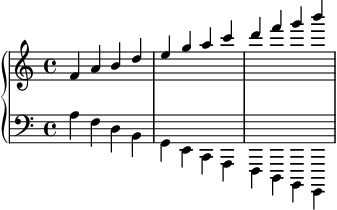
Anyway, to pull back to musical transformations. If we were to find some sort of music-aware Arrow instance, proc-notation is exactly what we’d want in order to “run patches” in our abstract modular synthesizer. That is to say, it provides the plumbing for moving music in and out of transformations. As a teaser for what’s to come, here’s a little example from my sandbox:
-- A horizontal pattern describing an unfolding dyadic voice-leading that
-- descends by fifth, before swapping the voices by moving away from one
-- another.
divergence = replicateH 12 $ foldMap dnote
  [ voiceLead 0 3
  , expand 0 1
  ]

song = horizontal $ resize 0.25 $ proc i -> do
  -- Compute an abstract voice leading over time
  vl <- liftH msumE <<< divergence -< i

  -- Apply that voice leading to the first two notes of a triad
  ns <- replicateH 12 $ with id -< applyVoiceLeading vl $ chord triad
  returnA -< ns
which describes this this nice little dyad expansion:
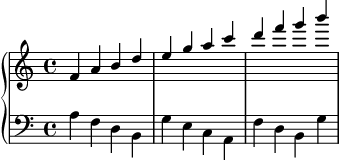
If we replace the last line with:
  -- Convert the "polyphony" into "counterpoint"
  let (lo :> hi :> Nil) = toV ns

  -- Clamp the lo voice so it stays within its register
  lo' <- liftH $ clampOctave (-9, 0) 0.5 -< lo

  -- Convert the "counterpoint" back into "polyphony"
  returnA -< fromV $ lo' :> hi :> Nil
we get this:
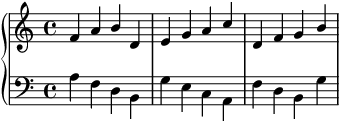
and of course we can also clamp the upper voice:
  -- Clamp the voices so they stay within their registers
  lo' <- liftH $ clampOctave (-9, 0) 0.5 -< lo
  hi' <- liftH $ clampOctave (0, 7) 0.5 -< hi

  -- Convert the "counterpoint" back into "polyphony"
  returnA -< fromV $ lo' :> hi' :> Nil
and we get this:
Now I’ll be the first to admit that this is a completely unusable DSL. But it does actually work! And if you squint, you can sort of see the modular synthesizer idea at play. Inside the proc notation, we are sampling all of our Signals simultaneously, but routing the output of (eg) the voice leading into the input of replicateH $ with id, which is what builds out the rhythmic pattern. Then we take the output of that, separate it into Signals of its constituent voices, and feed those into clampOctave, which moves a Signal’s notes into the given range of scale degrees.
Something cool but not pictured here, clampOctave takes a second argument (the 0.5) which tells it to look into the future and not perform any displacement if it would need to move again within that 0.5 of a measure. This is some sort of “retro-hysteresis” where signals can depend on their future values! Which sounds crazy when you’re thinking about wiring up synthesizers, but much less crazy when you’re sitting down writing out a score. Of course the notes in your score can depend on notes that happen later on in the song! One of the many benefits of explicitly modeling time in Signals.
Signal Functions
Hopefully you’re excited to see how we go about doing any of this acausal wizardry stuff. But it all starts from getting proc notation working. Which, recall, means we need a type to give an Arrow instance to.
Behold, the signal function (SF):
newtype SF a b = SF
  { runSF :: Signal a -> Signal b
  }
  deriving (Functor, Applicative) via WrappedArrow SF a
  deriving (Semigroup, Monoid) via Ap (SF a) b
which you will note is literally a function between Signals. Its Category instance comes immediately from Haskell functions’ instance:
instance Category SF where
  id = SF id
  SF g . SF f = SF (g . f)
The Arrow instance is similarly straightforward — separate out the product, run the functions on each half, then use the applicative instance to combine them back into a single Signal:
instance Arrow SF where
  arr = SF . fmap
  SF f *** SF g = SF $ \sg ->
    liftA2 (,) (f $ fmap fst sg) (g $ fmap snd sg)
That’s really all there is to it! We can give some means of introducing SFs:
constS :: Signal a -> SF x a
constS = SF . const
as well as a few primitives whose definition we don’t have time to get into:
-- | Create a single occurrence of an Event at the given time.
at :: Time -> a -> SF x (Event a)

-- | Convert a discrete stream into a continuous one, by holding the value of
-- the last event seen.
hold :: a -> SF (Event a) a

-- | Like 'hold', but backwards in time. Hold the value of the /next/ event that
-- will occur.
fhold :: a -> SF (Event a) a

-- | Stateful folds over Events
scanE :: (s -> a -> (s, b)) -> s -> SF (Event a) (Event b)

-- | Full-scale rewrites of Event streams
ev2ev :: ([(Time, a)] -> [(Time, b)]) -> SF (Event a) (Event b)

-- | Run the first SF until the 'Event' occurs, then switch into the
-- continuation.
switch :: SF a (b, Event c) -> (c -> SF a b) -> SF a b
(for completeness’ sake, there ought to be time-reverse versions of scanE and switch too!)
This seems like a good place to leave it for now. In the next post we’ll discuss how to turn all of this abstract machinery into something that actually resembles music.