From Instantaneous Events to Musical Spans
We’ve been thinking a lot about musical structures over these last few posts. Today we’re going to look into some rhythmic concerns, and in particular, figure out how to turn a discrete signal of instantaneous events into something that actually looks like music.
Recall that we’ve been working with a Signal a type, which is a continuous function of Time -> a, packaged along with a set of “interesting times” that we might be interested in looking at. We smuggle discrete events into these interesting times. But what makes a time interesting?
One immediate answer, musically, is “when something happens.” That something could be a point in the meter, a chord change, the beginning of a note, the end of a note, a modulation, the return of a motif, every time an A is played, etc. Essentially, whenever you might think a time is interesting :)
Of these, we’re primarily going to focus on the beginning and end of notes today. Since once we’ve sorted that bit out, we have the better part of a musical MVP. It’s not going to be anywhere close to the vision, but it’s a necessary step along the path.
So what we’ve built so far is an Event type, which demarks instantaneous and momentary things. We have a Signal type which models things-over-time. It seems likely that in order to play notes we’re going to want a Signal of Events of something. Let’s say MIDI notes for now, since it’s an obvious sort of “computer music” interface.
The problem of course is that Events are instantaneous, but audible things are not; they necessarily have a duration. I played around with data structures in the style of interval trees for a long time before coming to the conclusion that that way lies folly.
Instead what seems to be the play is to explicitly model Spans:
data Span a = Span
  { duration :: Time
  , getSpan :: a
  }
  deriving stock (Eq, Ord, Show, Functor, Foldable, Traversable, Generic)
and then just generate them in our Signal. So rather than talk about Event MIDINote, we instead use Event (Span MIDINote). This is very much in the style of “regular old music scores” where there is explicit syntax for encoding the span of a note:
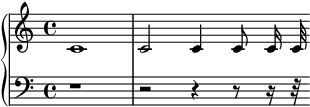
If you’re not familiar with music notation, the top line contains (after the funny “c” thing) the symbols for sounded notes. The first symbol takes up one unit of time, the next takes half that, and so on and so forth. The bottom line, in corresponding columns, are the same durations, except for silences rather than for sounded notes.
Anyway, the point here is namely that musicians are very much in the habit of thinking about “how long does this note sound for?” So attaching the Span to the note we want to play isn’t a very far-fetched idea at all.
That being said…
It turns out to be a drag to have to always be sticking durations on things. I suspect the pain is already internalized in some sort of Stockholm Syndrome, because every written notation and every computer program for music requires you to write down the damn durations.
As it happens, writing down the durations in advance is not very compositional. For example, if we stretch the time domain of our Signal (which is very reasonable and possible, since it’s just a function Time -> a), we’d expect the note durations to stretch too! But they can’t, since we’d have the type:
stretch :: Rational -> Signal a -> Signal awhich you’ll notice is polymorphic in a. Of course, we could do some ad-hoc bullshit where we stick in a typeclass constraint for “stretchable things” but this is the way of madness.
What if, instead, we were to derive the durations? After all, we already know when everything is, temporally-speaking. The first type that comes to mind for something like this would be:
SF (Event a) (Event (Span a))that is, a function over Signals, which takes an input stream of events and outputs a stream of events with a duration attached to them. What duration? Presumably until the next event! While this is a perfectly fine type (and isn’t very hard to implement), it has the obvious downside that it can’t represent silence. If a sound spans until the next sound, then there’s nowhere to stick any silence!
What I ended up with was to take two input event streams:
spanning :: SF (Event (), Event a) (Event (Span a))where the Event () stream indicates changes and the Event a stream indicates beginnings of notes. Thus a note spans until the next Event a or Event () — whichever comes first.
The implementation is not very tricky. We use our primitive
ev2ev :: ([(Time, a)] -> [(Time, b)]) -> SF (Event a) (Event b)and zip together the events with the tail of the events, taking the difference in their times. All that’s left is to combine the event streams, which is exactly what the Alternative instance on Event does:
spanning :: SF (Event (), Event a) (Event (Span a))
spanning = proc (end, a) -> do
  let merged = Just <$> a <|> Nothing <$ end
  ev2ev
    (\es -> catMaybes
      $ zipWith
          (\(t1, ema) (t2, _) -> case ema of
            Just a -> Just (t1, Span (t2 - t1) a)
            Nothing -> Nothing
          )
          es
      $ drop 1 es
    ) -< merged
I don’t know about you, but I think this is pretty cool. For two different reasons. The first is that we’ve accidentally just derived the notion of a musical voice, which is to say a logical grouping of musical events into something that could be sung by a person, or played on an instrument. Voices and (most) instruments only make one note at a time, which is exactly the postcondition of spanning.
The other cool thing here is that now we can change note lengths in the same way we can change chords and modulations — namely by doing transformations in SF. You can imagine a Signal Tension which describes how much tension the composer wants you to feel through the journey of the song. By deriving an event stream out of the modulating Tension, where events happen frequently in high tension situations, and less often under low tension, we can automatically drive note durations from our Tension parameter! I haven’t used a lot of DAWs, but my understanding is (and the clankers agree) that almost(?) no DAWs support duration as an automation. So we might be in terra nova over here!
Perhaps you’re starting to get a taste that maybe all of this “solving music” isn’t such a pipe dream after all. There’s clearly still a huge distance to travel before we’re anywhere close to anything useful, but the primitives do seem to be pulling their weight.
Of course, nobody wants to call spanning by hand, so next time we’ll see about finding nicer ways of generating horizontal structures.