What Composing Music Could Look Like
In the last post, we discussed the algebraic structure of horizontal structures. But I realized I haven’t actually communicated the argument behind why we might care about that algebraic structure. So rather than diving directly into the technical stuff I had planned for today, let’s hash that out first.
If you recall, where we ended up was an abstract type Signal a which I claim is a precursor to horizontal musical structures, with the following common algebras:
type Signal a
instance Functor Signal
instance Applicative Signal
instance Foldable Signal
instance Semigroup a => Semigroup (Signal a)
instance Semigroup a => Monoid (Signal a)
It’s worth considering what each of these ideas means, musically. And once we’ve sorted that out, it’s worth thinking about what other musical structure we might want on top.
We can think about a Signal a as being a continuous function of as over time, combined with a set of times that we’re actually interested in. So what exactly does that mean? The continuous function part is just there to fill in the details when we change our minds about what times we want to look at.
With our Functor instance, we can do per-note (or per-whatever is held in the horizontal structure) transformations. For example, fmap (+ 1) transforms
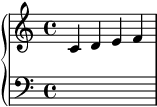
into
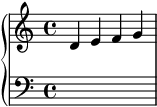
But it also does more interesting things; fmap (!! 1) (where !! n selects voice n) transforms
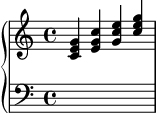
into
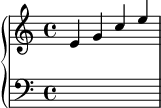
Furthermore, nobody says the a in Signal a need be something that is musically meaningful. A Signal is just a function from time to something; so we could do something crazy like building a Signal DayName that is a week-long signal moving from Monday to Sunday at a rate of one a day. We could then use the Functor instance to transform these labels into something more musically meaningful — perhaps into motifs or numbers of repeats, or something like that.
Our Semigroup instance gives us a <> operation, which combines things that happen at the same time. What it means to “combine things” depends on the things being combined. But as a little vibe check, we can use <> to smush together two little motifs:
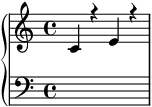
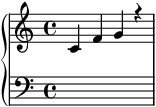
into
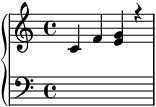
This example one is very vibes, so don’t read TOO much into it. The important part is that “things that happen at the same time get smushed together.” We’ll discuss in MUCH MORE DETAIL sometime in the future what sorts of smushing might be musically meaningful.
The Applicative structure is very similar to the Semigroup, except that instead of smushing things together, we can run a function that depends on the values in both things. This one is unfortunately impossible to show in standard musical notation, and wiring up some custom visualization isn’t a good use of my nanowrimo time.
But let’s use our IMAGINATION instead. Imagine a voice-leading that looks like this (realized over a C-major triad):
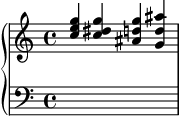
We can use our applicative instance to retarget the voice leading over any other chord. For example, given this one:
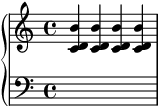
Invoking liftA2 applyVoiceLeading over these two musical pieces gives us this remarkable chord progression:
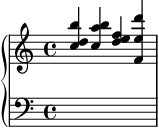
If you’re familiar with lots of harmony, you can see that both progressions are structurally equivalent — a neo-Riemannian P transform, followed by an efficient voice leading from CM to E#M, followed by the outer two voices switching pitch classes by moving in opposite directions.1
Of course, nothing requires us to use the same chord throughout. We can apply our same voice leading pattern to a series of changing chords, for example:
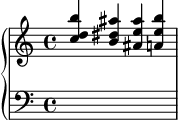
which results in
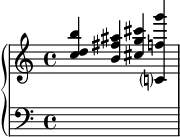
You’ll notice we’re getting very interesting results without doing much work at all. I picked some random voice leadings and some random chords, and the computer did all of the work of figuring out what notes I’m gesturing at.
Some other things you could do with this: instead of voice leadings, put scalar modulations. Or note durations! Or put voice numberings and project chords down to individual voices (which is different than the functor case, because here we can change which voice gets to sound.) Better yet, do all of the above, continuously, at different time scales.
What I think this ends up looking like in practice is something akin to a modular synthesizer. You can plug the outputs of different signals into the inputs of others. But unlike any modular synthesizer you’ve ever played with, here our signals are allowed to carry macroharmonies, voice leadings, modulations, tension, motifs, rhythm, registral expansion, dynamics, timbre, or even just arbitrary mathematical functions.
That’s probably enough for now. In the next post we’ll actually get around to looking at the implementation of Signal and then giving better composable semantics around it.
I extracted all the moves here from Tymoczko’s masterpiece Tonality: An Owner’s Manual.↩︎